
Certified True Copies / Digital Document Copies
Certified True Copies and Digital Document Copies
Certified true copies and digital document copies
For an Ontario certified true copy, a notary must inspect the original document and compare it with the copy in person. A scan, electronic copy, or digitally signed document is not automatically a certified true copy. If a document was issued electronically, acceptance and certification requirements depend on the receiving organization; confirm those requirements before booking.
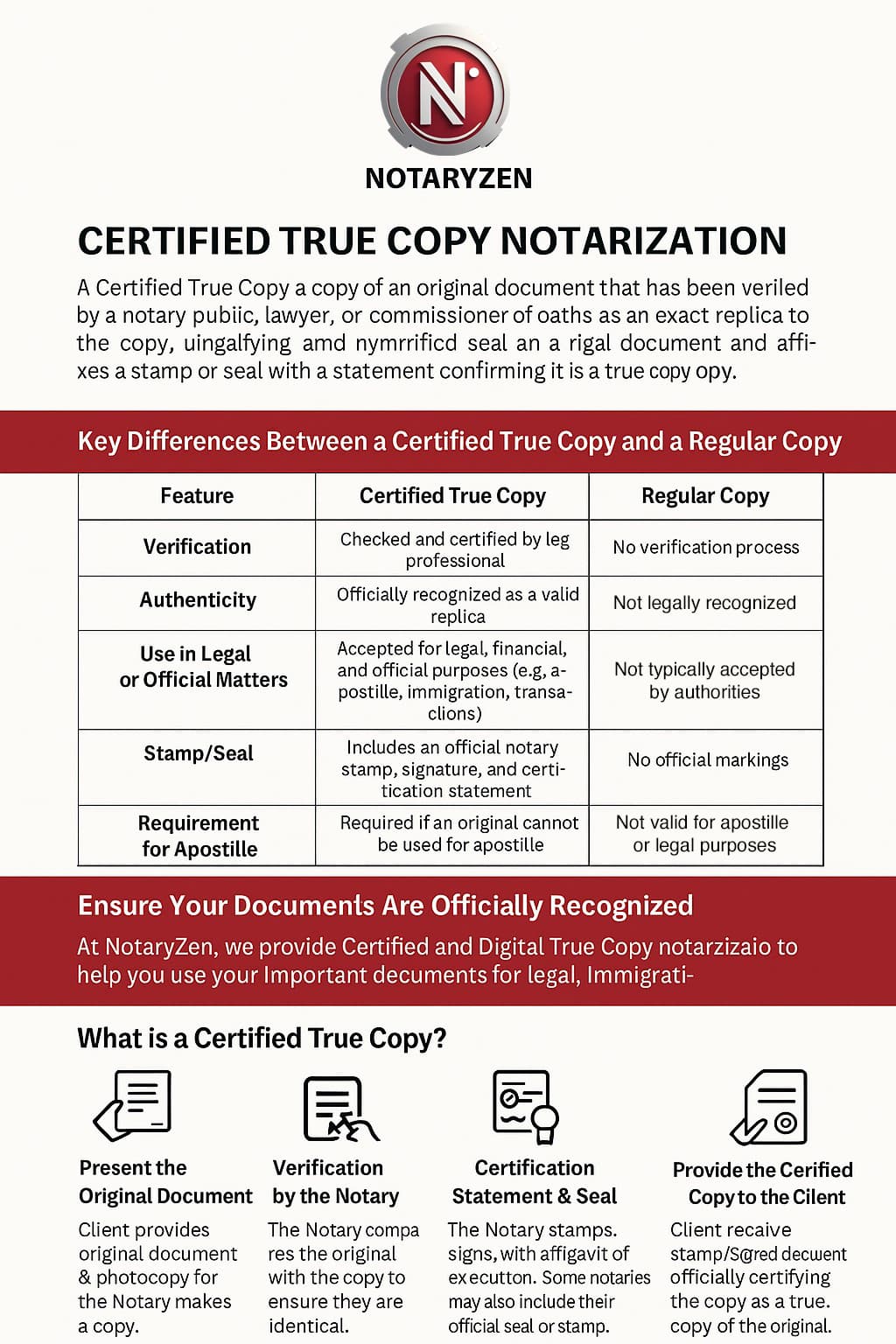
Certified True Copies of Original Documents (In Person)
Universally Accepted: Trusted by courts, banks, immigration offices (e.g., IRCC), academic institutions, and foreign embassies. Legal Authenticity: Carries the official seal and signature of a Notary Public in compliance with Ontario law. Accepted for Apostille / Legalization: Canada joined the Hague Apostille Convention (Jan 2024), making certified copies valid for international use. Comparison with the original: A certified true copy confirms that the copy matches the original document presented to the notary. It does not independently verify the authenticity or contents of the original. Recipient requirements: The receiving organization decides whether it will accept the certified copy and may impose document-specific conditions. Meets Institutional Requirements: Many official processes (immigration, legal proceedings, licensing, international travel) require notarized documents — not just simple photocopies.
About Digital Document Copies
Remote Access: Certify documents from anywhere in the world — ideal for busy professionals, rural residents, or international clients.
Time & Cost Efficient: No travel, parking, printing, or mailing — everything handled electronically.
Secure & Tamper-Evident: Certificate-based digital signatures and audit trails make the copy highly secure and traceable.
Instant Delivery: Receive notarized documents immediately via email or secure link.
Eco-Friendly: Reduces paper use and physical storage — aligns with digital transformation and sustainability goals.
How is a True Copy Certified?
Present the Original Document
Client provides the original document and a photocopy (or the Notary makes the copy).
Verification by the Notary
The Notary compares the original with the copy to ensure they are identical.
Certification Statement & Seal
The notary adds the required certification statement, signature, date, and seal or stamp.
Provide the Certified Copy to the Client
Client receives a stamped/signed document officially certifying the copy as a true copy of the original.
Documents That Can Be Certified as True Copies
Identification Documents
Passports, driver's licenses, health cards, birth certificates, marriage certificates, divorce decrees, separation agreements.
Government-issued Documents
Social Insurance Number (SIN) cards, Canada Pension Plan statements, Old Age Security statements, tax returns (T1 General), Notice of Assessment (NOA).
Financial Documents
Bank statements, credit card statements, loan agreements, mortgage documents, investment statements.
Educational Documents
Diplomas, transcripts, degrees, certificates.
Business Documents
Articles of Incorporation, business registration documents, partnership agreements, corporate resolutions.
Real Estate Documents
Deeds, mortgages, property tax bills, assessment notices.
Wills and Estate Documents
Wills, Powers of Attorney, Living Wills, estate plans.
Why Choose NotaryZen for Certified True Copies
- In-person service by an Ontario notary acting within the scope of their appointment.
- Fast & Convenient — mobile notary is available at your home, office, or preferred location.
- Professional — secure and confidential service.