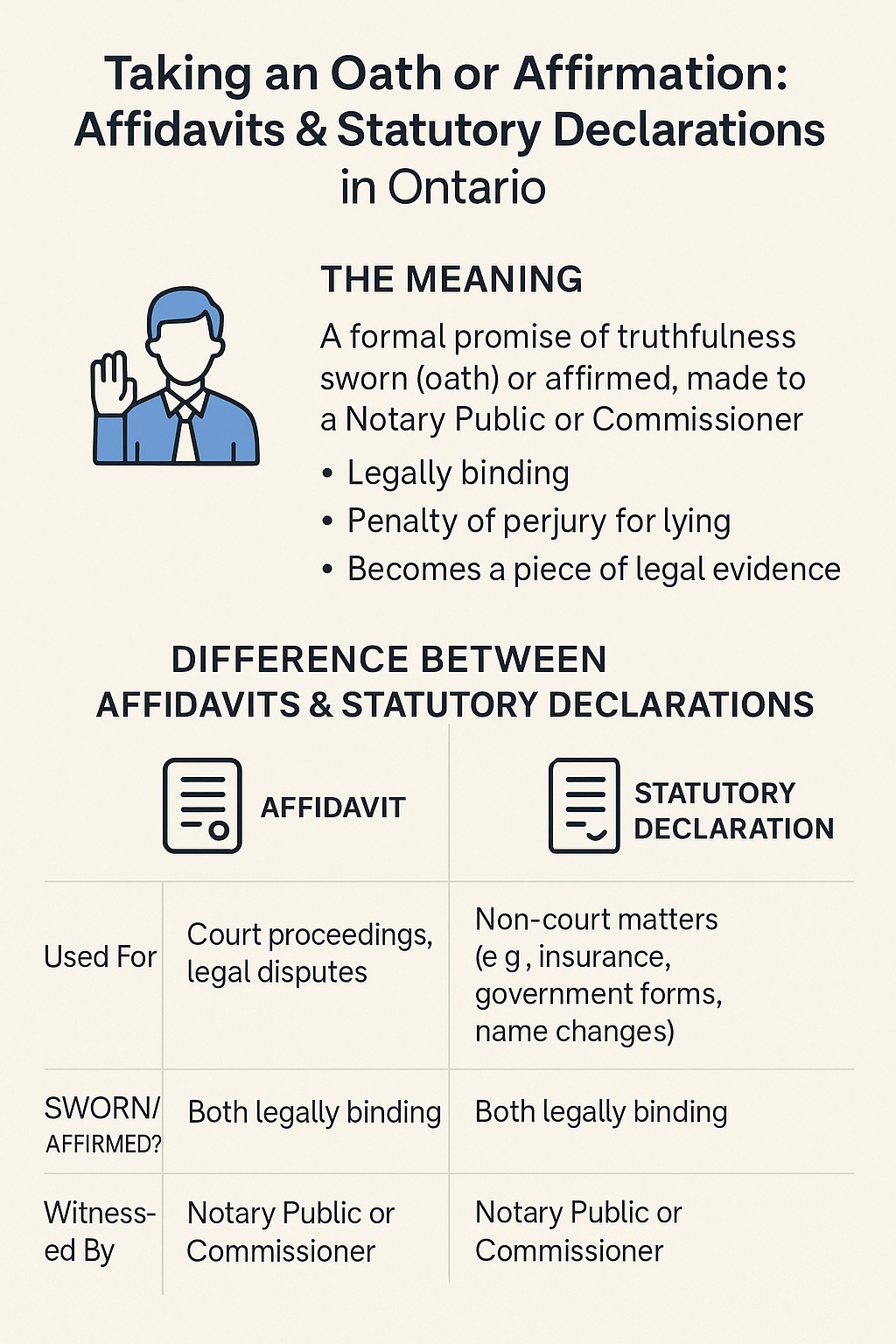
⚖️ Affirmation vs. Oath: What's the Difference?
| Feature | Oath | Affirmation |
|---|---|---|
| Definition | A solemn promise invoking a higher power (e.g., God) | A non-religious solemn declaration |
| Used by | Individuals with religious beliefs | Individuals with no religious beliefs or preferences |
| Language | Includes references to God or a deity | Secular, no religious references |
| Legal Standing | Equal – both are legally binding declarations | Equal – both are legally binding declarations |
✅ Essentials for Notaries When Administering Either
| Step | Explanation |
|---|---|
| 1. Verify Identity | Confirm identity using valid photo ID (passport, driver's licence, etc.) |
| 2. Ensure Voluntariness | Make sure the individual is not under duress and is signing willingly |
| 3. Ask Their Preference | Ask: "Do you wish to swear an oath or affirm the truth of your statement?" |
| 4. Administer Proper Statement | Use the appropriate wording (see examples below) |
| 5. Sign and Date | Have the declarant sign the affidavit in your presence; you sign and stamp |
✅ A Notary Public CAN Notarize:
Here's a list of estate documents a notary public in Ontario may be asked to notarize — strictly in the capacity of witnessing signatures, administering oaths, or certifying copies:
✍️ Affidavits & Declarations related to estate matters:
- Affidavit of Execution of a Will (often required for probate)
- Affidavit of Witnessing a Power of Attorney
- Affidavit of Death
- Affidavit of Service (for service of documents in estate proceedings)
- Statutory Declaration of Identity or Relationship
📄 Certified Copies of Documents:
- Certified true copy of a Will (for non-probate purposes, or international use)
- Certified copy of a Power of Attorney (Property or Personal Care)
- Certified copy of a Death Certificate (often required for estates)
- Certified copy of a Passport or ID (used for estate or trust verification)
🌐 International Documents for Estates:
- Notarized translations or copies of estate documents being sent abroad
- Sworn statements or affidavits used in foreign probate or inheritance proceedings (common with dual citizenship cases)
❌ A Notary Public CANNOT Notarize:
- Draft or review wills, codicils, trusts
- Interpret powers of attorney (for property or personal care)
- Provide legal advice on estate planning or estate administration
- Act as an executor or legal representative of the estate